Logo der Universität Wien

Department for Geodynamics and Sedimentology

Research at the Department of Geodynamics and Sedimentology focuses on pure and applied research into both ductile/brittle lithospheric and Earth-surface processes. Field-based geology and quantitative modeling of geodynamic processes form the foundation of academic and applied Earth sciences research, in particular in petroleum geology and seismology. A close collaboration between research groups focuses on integrated geodynamics/tectonics and sedimentology/stratigraphy.

Head: Bernhard Grasemann, Jörn PeckmannMichael Wagreich


News


Thursday, 5. January 2012

Dating the Badenian Stratotype by orbital cycles

Michael Wagreich published together with Johann Hohenegger a paper on cyclostratigraphic dating of the gone Badenian stratotype in the last issue of the International Journal of earth Sciences
The stratotype of the Paratethyan Badenian stage (Middle Miocene, Langhian) is situated in a brickyard pit at Sooß, south of Baden (Vienna Basin), that has been used since several years as a waste dump. Orbital cyclostratigraphy from a 100 m scientific well core and a sample set taken from the former outcrop were combined to give a calibrated absolute age for the core and stratotype section from 14.221 to 13.964 Ma, which is considerably younger than previously thought. Consequences for the correlation of the Badenian stage and it's subdivision, especially the middle Badenian, are discussed in the paper.


Hohenegger, J. and Wagreich, M., 2011. Time calibration of sedimentary sections based on insolation cycles using combined cross-correlation: dating the gone Badenian stratotype (Middle Miocene, Paratethys, Vienna Basin, Austria) as an example. International Journal of Earth Sciences, 101, 339–349.DOI 10.1007/s00531-011-0658-y. 

link to the article


Schober and Exner
Hofer et al.
Wagreich et al.

Thursday, 5. January 2012


3 papers in Austrian Journal of Earth Sciences (AJES) 104/2

The new issue 104/2 of the Austrian Journal of Earth Sciences is online at http://www.univie.ac.at/ajes/archive/volume_104_2/ and includes 3 papers from our department dealing with Cretaceous rocks in eastern Austria:

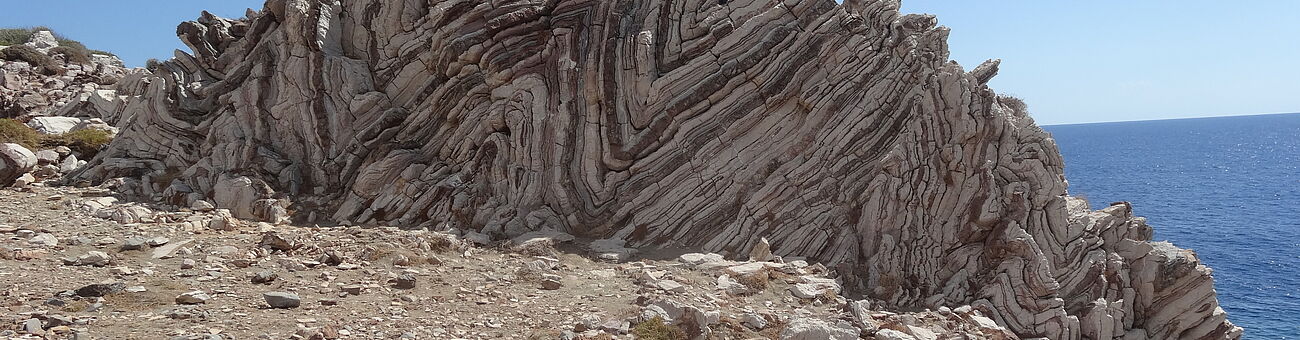
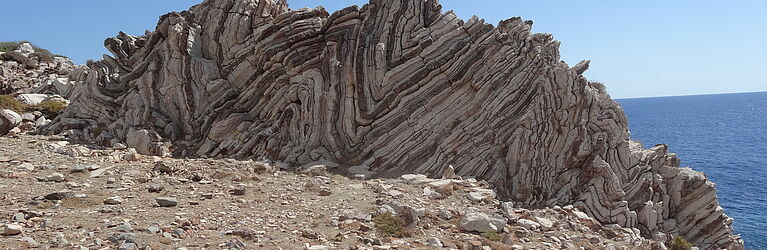
Andrea Schober & Ulrike Exner: 3D structural modelling of an outcrop-scale fold train using photogrammetry and GPS mapping link to the article

Gerald Hofer, Erich Draganits, Michael Wagreich, Christa-Charlotte Hofmann, Doris Reischenbacher, Marie-Louise Grundtner & Magdalena Bottig: Stratigraphy and geochemical characterisation of Upper Cretaceous non-marine – marine cycles (Grünbach Formation, Gosau Group, Austria)
link to the article

Michael Wagreich, Tania Ilickovic, Aleksandra Popovic, Clemens Porpaczy, Johannes Steinbrenner & Godfrid Wessely: Biostratigraphy and sedimentology of Campanian deep-water sections (Nierental Formation, Gosau Group) in Lower Austria
link to the article


Wednesday, 14. December 2011

Merry Christmas and a Happy New Year whishes the Department for Geodynamics and Sedimentology

Distinct Element Method (DEM) model of Santa and his reindeers on a collision course. The model was designed by Martin Schöpfer and run using the PFC2D software.

click to start the movie


Tuesday, 29. November 2011

Journal of Structural Geology paper on displacement length scaling of brittle faults in ductile shear

Bernhard Grasemann, Ulrike Exner and Cornelius Tschegg published a new paper about "Displacement–length scaling of brittle faults in ductile shear" in the Journal of Structural Geology. The study demonstrates cataclastic flow in brittle faults during ongoing ductile deformation of the host rocks. These structures record one of the greatest maximum displacement/length ratios reported from natural fault structures.

Grasemann, B., Exner, U., and Tschegg, C., 2011, Displacement–length scaling of brittle faults in ductile shear: Journal of Structural Geology, v. 33, no. 11, p. 1650-1661.

link to the article


Monday, 07. November 2011

Festkolloquium zu Ehren von Ao. Univ. Prof. Dr. Leopold Krystyn und Ao. Univ. Prof. Dr. Richard Lein

Freitag, 18.11.2011, 14:15 bis 17:15 Uhr

Universität Wien, Althanstraße 14 (UZA II), Hörsaal 2 (2A122)
Department für Geodynamik und Sedimentologie und Institut für Paläontologie

Programm
14:15 – Begrüßung
14:20 – Werner Piller: Laudatio
15:00 – Alexander Lukeneder: Ammoniten-Forschung modern - von der Trias                       bis heute
15:30 – Kaffeepause
16:15 – Gerhard Mandl: Von der Kalkalpinen Trias zum juvavischen Puzzle
16:45 – Sylvain Richoz: Fortschritte bei der Stratigraphie der Trias im Bereich                      des Tethys- Ozeans und paläoökologische Implikationen


Im Anschluss an die Veranstaltung treffen wir uns um 18:30 Uhr bei einem Heurigen in Nußdorf zum gemeinsamen Abendessen.


Wednesday, 02. November 2011

11th Stable Isotope Network Austria (SINA) Meeting on 4th and 5th of November

- Final program now online.

The 11th Austrian Stable Isotope User Group Meeting is jointly organized by the Department of Chemical Ecology and Ecosystem Research (Faculty of Life Sciences) and the Department of Geodynamics and Sedimentology (Faculty of Earth Sciences, Geography and Astronomy), both University of Vienna. Stable isotope analyses provide exciting new approaches in a variety of current research topics ranging from Earth and Biological to Forensic and Medical Sciences. This meeting aims to bring together researchers and students in an informal workshop-like atmosphere to improve communication and interaction within and across disciplines and institutions. The meeting will include invited and contributed talks, as well as poster presentations.

The meeting will take place on November 4th and 5th in the Lecture Hall 2, Geocenter, UZA 2, Althanstr. 14, Vienna. For further information see the 2nd circular


Wednesday, 12. October 2011

Earthquakes in caves on Kalymnos and Pserimos (Greece)

September 2011: Bernhard Grasemann and Lukas Plan (Museum of Natural History Vienna) supported by the speleologist Wendy Reusens visited several caves on the islands of Kalymnos and Pserimos. Besides new cave surveying and mapping, the research was focused on evidences for active tectonic deformation or earthquakes in speleothems (e.g. broken stalagmites, stalactites or flowstones). The karst caves formed in calcite and dolomite marbles along the damage zone of inclined brittle faults. The discovered outcrops of speleothem seismites exceeded all expectations: All visited caves hosted abundant evidences of tectonic broken speleothems and fallen stalagmites. Relative neotectonic movements like systematic offsets of stalactites against stalagmites in the observed caves will help to quantify large earthquakes in this region.


Friday, 07. October 2011

Digital field mapping with DraganFlyer X6

The field mapping campaign of Bernhard Grasemann, Cornelius Tschegg, Benjamin Huet and Hugh Rice in Greece this September was supported by the use of a Draganflyer X6 RC helicopter (www.draganfly.com). The possibility to apply individual aerial photography opens up a new generation of field mapping, providing the documentation of geological features at a scale neither resolvable from satellite images nor from outcrop observation. The presented aerial photos were taken with the X6 and show geological details of a large area at a glance. It proved to be very useful for mapping structures like mega-grooves in a knife-sharp detachment plane of a low angle normal fault on Serifos.

Department for Geodynamics and Sedimentology
University of Vienna

Althanstrasse 14
A-1090 Vienna

T: +43-1-4277-534 01
F: +43-1-4277-95 34
University of Vienna | Dr.-Karl-Lueger-Ring 1 | 1010 Vienna | T +43-1-4277-0